
PART 1 OF 2 · RESUME SERIES
Most resumes we see from hospitality candidates aren’t failing because the person lacks experience. They fail because the resume hides it—buried under a passport number nobody asked for, a job title so vague it could belong to anyone, or a typo in the name of the city they’re applying from. None of that takes a rewrite to fix. It takes about fifteen minutes and a willingness to cut.
Clean up your header first
Start at the top. Your header should tell a recruiter exactly who you are and how to reach you — full name, professional title, city and country, phone number, a professional email address, and a LinkedIn link if it’s worth including. That’s it. Marital status, national ID numbers, passport numbers, a parent’s name — none of it belongs on a resume for an international hotel brand, and every line you spend on it is a line you’re not spending on the experience that actually gets you hired.
One note before you start cutting: that advice fits international resorts and hotel chains. If you’re applying to a Dominican-owned company, the traditional local format still includes a photo and a cédula. Our guide to the Dominican Republic vs. international CV format explains which version to use and when, and it has free CV examples in both Spanish and English.

Make your job title do the work
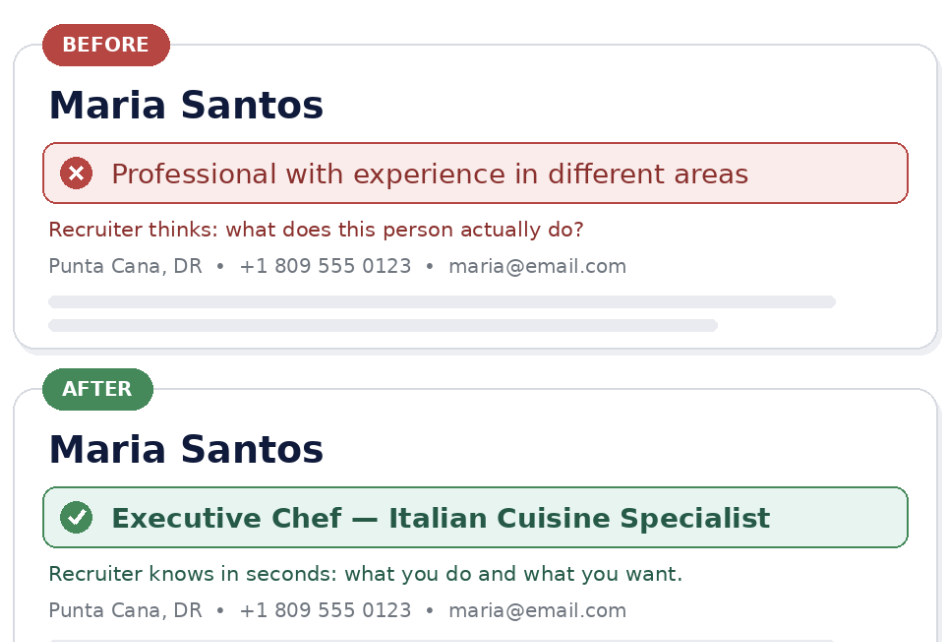
Right below that header sits the line doing the most work on the entire page: your job title. “Professional with experience in different areas” is the kind of title that makes a recruiter scroll past because it doesn’t give them anything to act on. Compare that to “Executive Chef — Italian Cuisine Specialist” or “Front Office Agent — Guest Services.” Those titles answer two questions before the recruiter has read a single bullet point: what do you do, and what are you looking for. If your title can’t do that in one line, it’s not ready yet.
Proofread, then send less
Then there’s the fix nobody wants to hear, because it feels too small to matter: proofreading. It matters more than almost anything else on this list. A resume that reads “Santa Domingo” instead of “Santo Domingo” isn’t judged as a typo — it’s judged as carelessness, and carelessness is exactly what a hotel can’t afford on the front desk or in the kitchen. Read your resume out loud once, then run it through a spellchecker. Two passes catch almost everything, and they cost you five minutes.
While you’re cleaning things up, take a hard look at what you’re attaching. A resume isn’t a document folder, and stapling on recommendation letters, a police clearance certificate, copies of certificates, passport pages, and reference letters doesn’t make you look thorough — it makes the actual resume harder to find. Keep those documents ready to send, and send them only when an employer specifically asks for them. DO NOT FORGET: Run spell check on your document before sending.
Get the photo right, or skip it
Last: the photo, if you’re using one. Hospitality resumes in many markets do include a headshot, and that’s fine — as long as it’s a professional, recent photo appropriate for the industry. A vacation selfie, a cropped-out group photo, or a casual shot from social media undercuts everything else on the page. And whatever photo you choose, it should never take up more visual space than your experience does. The photo gets you noticed. The experience gets you hired.

What comes next
That’s five changes, about fifteen minutes each, and not a single one requires you to rewrite a sentence of your work history. Do them today and your resume is already sharper than it was this morning.
But clarity at the top only gets a recruiter to keep reading — it doesn’t win them over. That happens further down, in the sentences describing what you actually did in each role, and that’s a harder problem than trimming a header. In Part 2, we’ll get into it: how to write a professional summary that says something instead of nothing, how to turn a job duty into an achievement a recruiter remembers, and why the specific words you choose end up mattering more than how many of them you use.
Which of these five fixes did your resume need most? Tell us in the comments — and if you want a second pair of eyes, ask.
RELATED READING
→ Dominican Republic vs International CV Format — What’s Different?
→ Free resources for Punta Cana job seekers
→ More guides on the Jobs Punta Cana blog
Looking for work in Punta Cana before or after you relocate?